Democratizing the Construction of Multiple Reciprocal Frame Structures using Adaptive Connectors
Posted
06.08.2024
Author
Shrey Gupta
Length
300 words

Authors: Shrey Gupta, Olga Popovic
Abstract
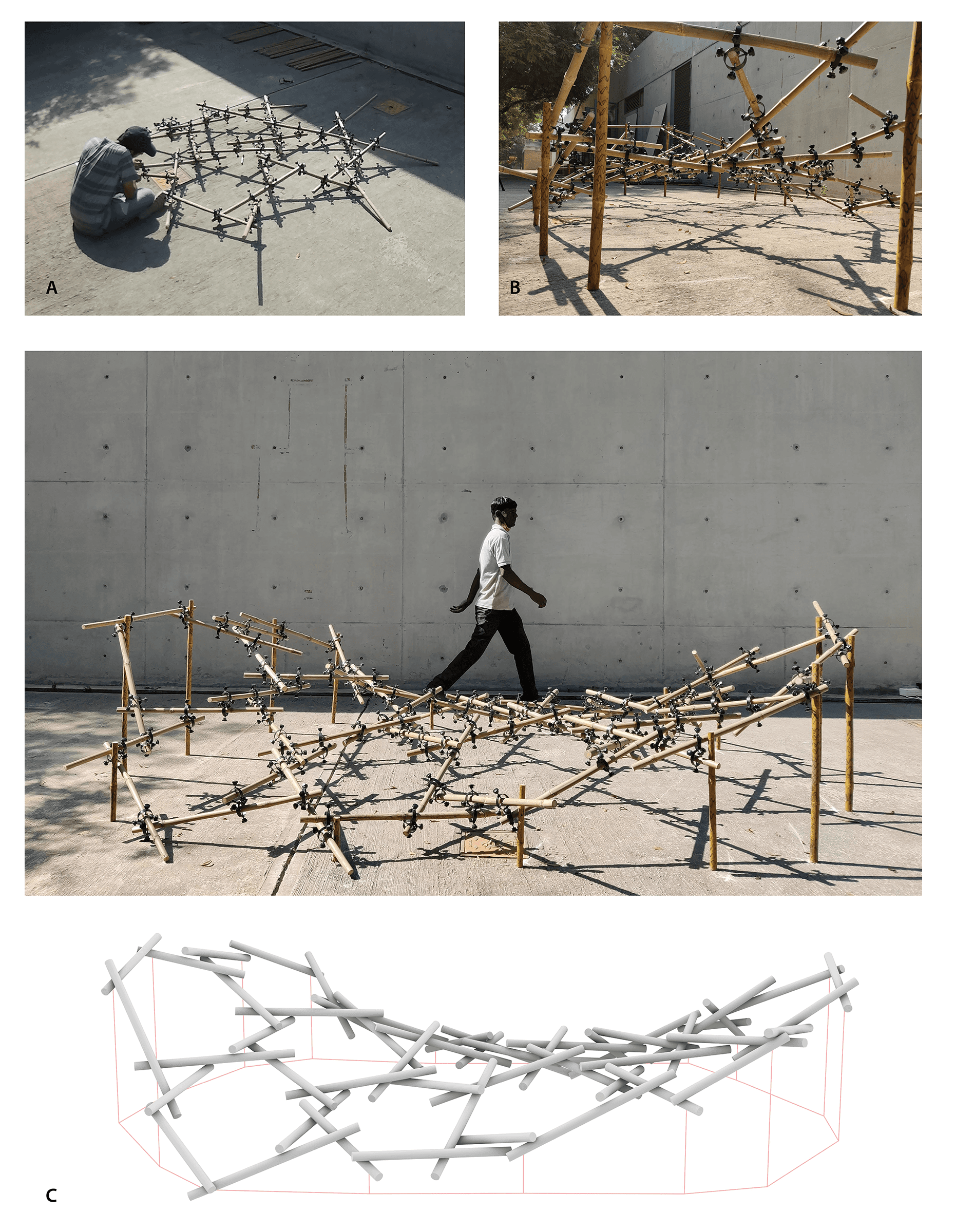
Even with the technological advancements today, there is a vast gap of buildability between design and execution of large-scale Reciprocal Frame Structures (RF structures). There are abundant tools available to generate and analyse complex RF structures, like ‘Shift Frame Geometry’ by ARUP and ‘Reciprocalizer’ by Dario Parigi and Paul but none to tackle the production of its complex junction typology & member orientations. This paper seeks to bridge that gap by developing an adaptive mechanism for the junctions. First goal of the research is to formulate a problem statement and target the critical adaptability factors using existing literature. These established factors are tested using prevailing junction typologies of RF structures and analysed through Construction & Performance Parameters. Second goal of the research focuses on developing the adaptive mechanism by prototyping using this collected data. Thus, the design evolves into a swivel-ring coupler with a unique riveting system that provides the required tolerances for deviations of non-standard members at local and global system levels. The paper concludes with a successful construction of a 1:1 scale anticlastic multiple RF structure as an architectural application using only the adaptive connector, solid bamboo and simple manual fitting as a proof of concept. Whence evolved further, these connectors can be mass produced as construction kits for customized applications of emergency shelters, deployable tents or large-scale community projects.
Keywords: Reciprocal Frame Structures, Adaptive Connector, Non-standard Member, Rapid Construction, Buildability, anticlastic Surface Structures, Fabrication, Swivel-Ring Coupler, Riveting System.
Authors: Shrey Gupta, Olga Popovic
Abstract
Even with the technological advancements today, there is a vast gap of buildability between design and execution of large-scale Reciprocal Frame Structures (RF structures). There are abundant tools available to generate and analyse complex RF structures, like ‘Shift Frame Geometry’ by ARUP and ‘Reciprocalizer’ by Dario Parigi and Paul but none to tackle the production of its complex junction typology & member orientations. This paper seeks to bridge that gap by developing an adaptive mechanism for the junctions. First goal of the research is to formulate a problem statement and target the critical adaptability factors using existing literature. These established factors are tested using prevailing junction typologies of RF structures and analysed through Construction & Performance Parameters. Second goal of the research focuses on developing the adaptive mechanism by prototyping using this collected data. Thus, the design evolves into a swivel-ring coupler with a unique riveting system that provides the required tolerances for deviations of non-standard members at local and global system levels. The paper concludes with a successful construction of a 1:1 scale anticlastic multiple RF structure as an architectural application using only the adaptive connector, solid bamboo and simple manual fitting as a proof of concept. Whence evolved further, these connectors can be mass produced as construction kits for customized applications of emergency shelters, deployable tents or large-scale community projects.
Keywords: Reciprocal Frame Structures, Adaptive Connector, Non-standard Member, Rapid Construction, Buildability, anticlastic Surface Structures, Fabrication, Swivel-Ring Coupler, Riveting System.