The Small Little Foundations of a Pervasive Social Change
Posted
06.11.2019
Author
Shrey Gupta
Length
800 words
A Sense of Belonging
The word “community/society” represents the most basic instinct which make us human – The need for affiliation, the desire to belong and to be part of something bigger.
In this day and age, humans have no dearth of resources and connectivity. But the distribution of these fruits of modernisation have been more favourable towards the top of the social pyramid. What if we could use these fruits to change the game and reform community at a larger scale?
Bholu 14, Anganwadi, Ahmedabad
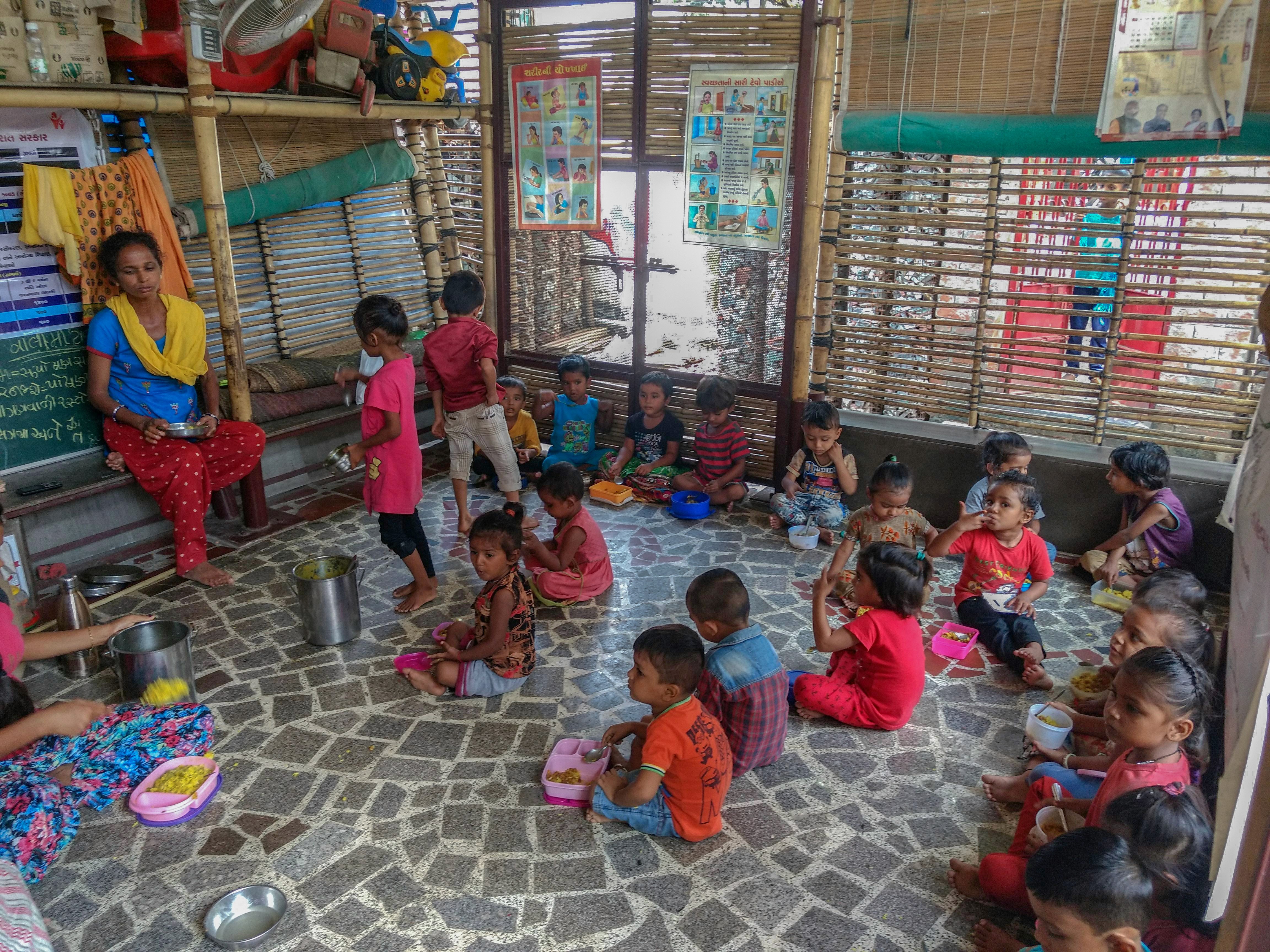
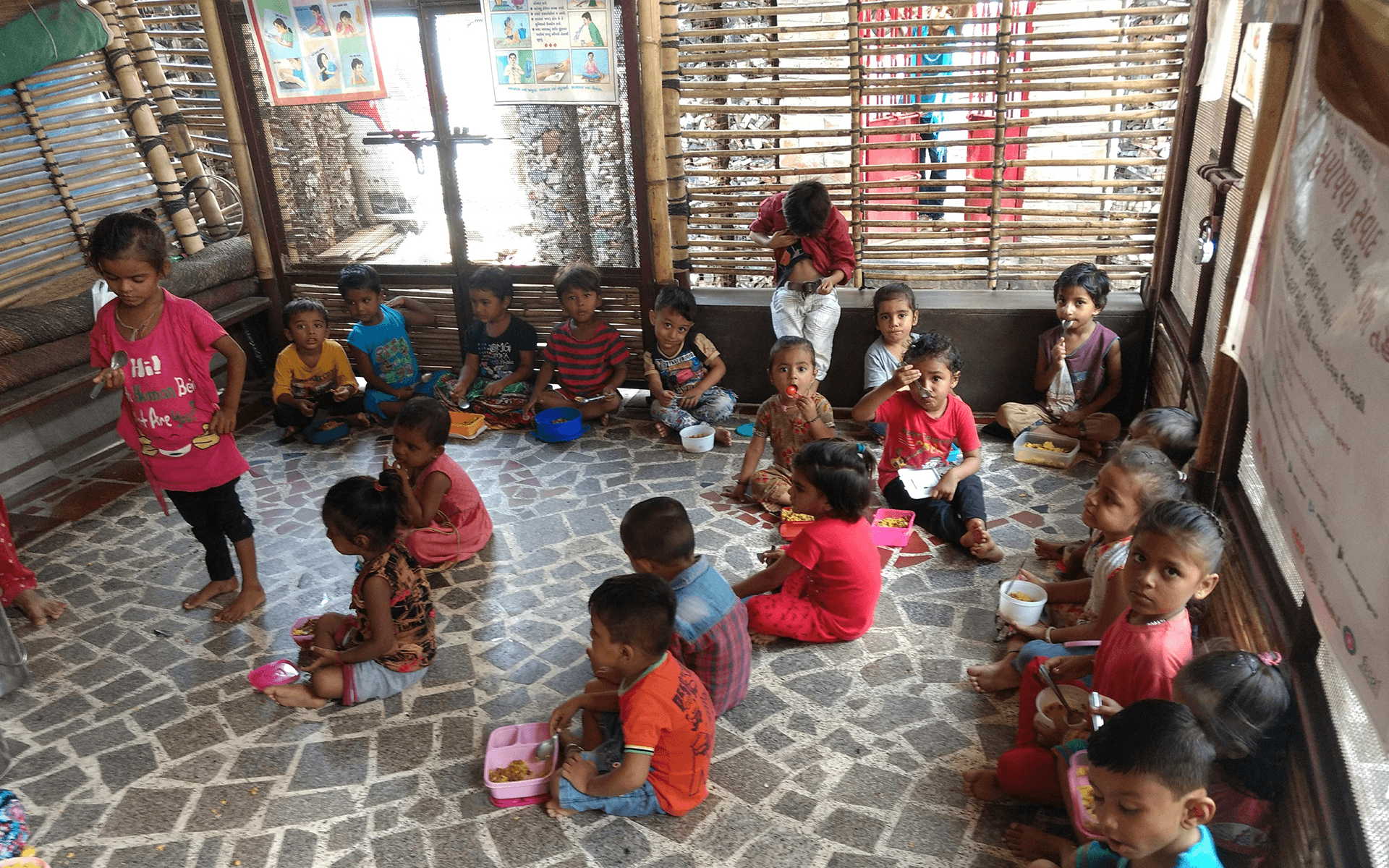
Prime example of this is a very small Anganwadi (Playgroup), Bholu 14, a rural health care centre in the dense fabric of slum houses at Sabarmati, Ahmedabad. This elementary project is clearly summarised by its name, “Anganwadi”, where “Angan” means domestic courtyard and “Wadi” means shelter. A domestic shelter to provide the perishing slum neighbourhood with basic health care necessities like nutrition supplements, contraceptive counselings and even pre-school education. Spread over an area of 25 square meters, this project is designed as a deployable bamboo frame structure with split bamboo screens to counter the unprecedented eviction of the community. Unlike other government Anganwadis, this one has been a collaborative effort from its conceptualisation to execution with the entire community continuously evolving the design to match their needs. Thus, the architects and agencies are not the designers here but execution agents executing the community’s vision. It has been pivotal in empowering the people as the dump yard land now generates revenue for the landlord while the female caretakers are financially supporting their families. But above all, it has brought hope for a healthy and secure future of the community.
Friend's Society, Vadodara
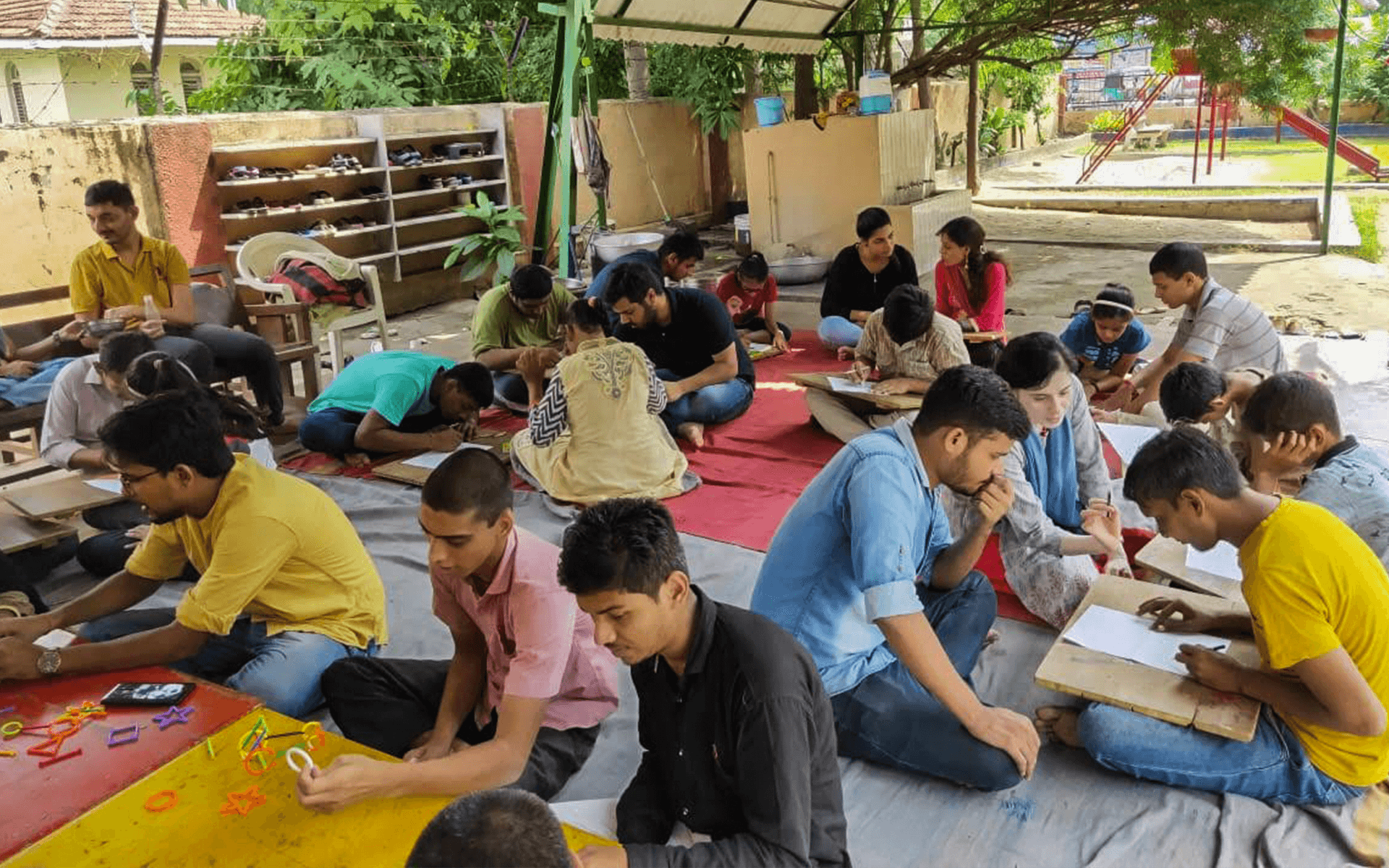
While Bholu 14 has an elaborate design process and a manifested physical entity, the NGO, Friends Society, shows how sometimes needs of the community can be catered by “not building” in the first place. Established in 1970, it sits amidst the hustling area of Fatehgunj, Vadodara, holding a greater social and moral value as it relies on volunteers from nearby colleges working pro bono! It has been providing aid to the specially challenged and underprivileged by doing pioneering work to create a rejuvenating environment for their growth. Designer and volunteers have developed a unique language, with small existing brick structures converted to storage rooms which then became anchors for temporary structures around it. Open from all sides, these structures allow easy circulation and provide a premise to interact with nature. Existing forms and added extensions create this synergy inhabiting various functions like Open Library, Sunday School workshops for the specially challenged, Youth Club activities for teens from neighbouring slums and sewing classes to empower women.
Value them
These small inserts have brought a significant change in the education, livelihood and social acceptance of the underprivileged communities of India. In a parallel conversation the narrative can delve into issues of storage, amenities and evolution of the projects with the communities growing exponentially. These spaces are a testimony to how basic functional infrastructure created by a harmony between the architect and people, has the power to transform the social and economic fabric of a community.
A Sense of Belonging
The word “community/society” represents the most basic instinct which make us human – The need for affiliation, the desire to belong and to be part of something bigger.
In this day and age, humans have no dearth of resources and connectivity. But the distribution of these fruits of modernisation have been more favourable towards the top of the social pyramid. What if we could use these fruits to change the game and reform community at a larger scale?
Bholu 14, Anganwadi, Ahmedabad
Prime example of this is a very small Anganwadi (Playgroup), Bholu 14, a rural health care centre in the dense fabric of slum houses at Sabarmati, Ahmedabad. This elementary project is clearly summarised by its name, “Anganwadi”, where “Angan” means domestic courtyard and “Wadi” means shelter. A domestic shelter to provide the perishing slum neighbourhood with basic health care necessities like nutrition supplements, contraceptive counselings and even pre-school education. Spread over an area of 25 square meters, this project is designed as a deployable bamboo frame structure with split bamboo screens to counter the unprecedented eviction of the community. Unlike other government Anganwadis, this one has been a collaborative effort from its conceptualisation to execution with the entire community continuously evolving the design to match their needs. Thus, the architects and agencies are not the designers here but execution agents executing the community’s vision. It has been pivotal in empowering the people as the dump yard land now generates revenue for the landlord while the female caretakers are financially supporting their families. But above all, it has brought hope for a healthy and secure future of the community.
Friend's Society, Vadodara
While Bholu 14 has an elaborate design process and a manifested physical entity, the NGO, Friends Society, shows how sometimes needs of the community can be catered by “not building” in the first place. Established in 1970, it sits amidst the hustling area of Fatehgunj, Vadodara, holding a greater social and moral value as it relies on volunteers from nearby colleges working pro bono! It has been providing aid to the specially challenged and underprivileged by doing pioneering work to create a rejuvenating environment for their growth. Designer and volunteers have developed a unique language, with small existing brick structures converted to storage rooms which then became anchors for temporary structures around it. Open from all sides, these structures allow easy circulation and provide a premise to interact with nature. Existing forms and added extensions create this synergy inhabiting various functions like Open Library, Sunday School workshops for the specially challenged, Youth Club activities for teens from neighbouring slums and sewing classes to empower women.
Value them
These small inserts have brought a significant change in the education, livelihood and social acceptance of the underprivileged communities of India. In a parallel conversation the narrative can delve into issues of storage, amenities and evolution of the projects with the communities growing exponentially. These spaces are a testimony to how basic functional infrastructure created by a harmony between the architect and people, has the power to transform the social and economic fabric of a community.